
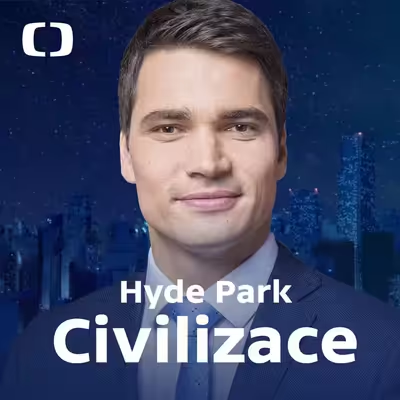
Hyde Park Civilizace

Hyde Park Civilizace

Věda a současná civilizace. Interaktivní rozhovory se světovými odborníky, ve kterých je prostor pro vaše otázky a komentáře. Moderuje Daniel Stach.

Podcast Hyde Park Civilizace je vložený na túto stránku z otvoreného informačného zdroja RSS. Všetky informácie, texty, predmety ochrany a ďalšie metadáta z informačného zdroja RSS sú majetkom autora podcastu a nie sú vlastníctvom prevádzkovateľa Podmaz, ktorý ani nevytvára ani nezodpovedá za ich obsah podcastov. Ak máš za to, že podcast porušuje práva iných osôb alebo pravidlá Podmaz, môžeš nahlásiť obsah. Ak je toto tvoj podcast a chceš získať kontrolu nad týmto profilom klikni sem.

Zoznam epizód (563 epizód)

54:55
  
19.02.2020

Harald Zur Hausen (virologist)

Around a quarter of million women around the world die every year of cervical cancer. Protection is vaccination. Prior to the development of vaccine it was necessary to find out what the cause of the disease is. And that is what professor Harald zur Hausen did. He discovered papilomaviruses that cau...
54:51
  
19.02.2020

Bernard Bigot (director-general of ITER tokamak)

In a special broadcast of Hyde Park Civilisation we visit Institute of plasma physics of the Czech Academy of Sciences. The reason is simple - our guest is head of International Thermonuclear Experimental Reactor. ITER should bring a revolution into harnessing of power - clean, safe and virtually in...
54:15
  
19.02.2020

Irina Bokova (director-general of UNESCO)

This cultural cleansing is a warcrime that is now used as a tactics of war. Says Irina Bokova, director general of UNESCO, when she described the destruction of monuments - among others - in Syria and Iraq. How to prevent terrorists from destroying thousands of years old statues or buildings? What o...
54:57
  
19.02.2020

Johann-Dietrich Wörner (director general of European Space Agency)

After the beginnings of astronomy, after the times of Apollo programme and ISS a new era is about to start. It will include for example village on the Moon as well as journey to Mars. This is how the current of state of space exploration is decribed by the director general of ESA, professor Johan-Di...
55:08
  
19.02.2020

Douglas Vakoch (President of METI International)

Dr. Douglas Vakoch, President of METI International – an organization that keeps pushing the SETI project. Literally further into space. He and his team are searching for extraterrestrial civilizations and are working on a message that they want to send to space. How should it be written? What shoul...
55:09
  
19.02.2020

Professor Benno Willke

„Ladies and gentlemen, we have detected gravitational waves. We did it.“ Said David Reitze, LIGO Laboratory Executive Director. And Einstein´s theory of relativity was proven. Moreover, scientists have opened a new window into space. They are comparing it to the moment when Galileo Galilei turned hi...
57:53
  
19.02.2020

Hyde Park Cilizace ENG - Jerome Friedman (co-discoverer of quarks)

Professor Jerome Friedman was awarded the Nobel Prize for the discovery of quarks – the smallest known particles in nature. He has been working at MIT for 65 years now, and one of his teachers was Enrico Fermi – one of the fathers of the first nuclear reactor and the atomic bomb. What was he like in...
58:25
  
19.02.2020

Paul Nurse (geneticist)

A laureate of the Nobel Prize in Physiology. A president of the British Royal Society. A pilot, biker, innovator and experimenter who failed a university entrance exam six times. Sir Paul Nurse. He researches the division of cells – the fundamental question for cancer research. Why did he research o...
58:26
  
19.02.2020

Scott Parazynski (astronaut)

He went to space five times. He was a part of the first US-Russian space walk. He kept improving the safety of space shuttles after the Columbia disaster. He violated NASA regulations to save equipment worth billions of dollars. How did it feel to walk in space? How did John Glenn, the first US astr...
57:45
  
19.02.2020

Gerard't Hooft (theoretical physicist)

Gerard 't Hooft. A laureate of the Nobel Prize in Physics. He described how particles behave after they collide and elucidated the quantum structure of electroweak interactions. He says that we will have intelligent computers. And that Mars should be a one-way ticket only. And that we all should bui...
56:12
  
19.02.2020

Timothy Snyder (history professor)

There are bloodlands between Hitler’s empire and Stalin’s empire. The victims of the biggest demographic and humanitarian catastrophe that man has ever caused in human history. A total of 14 million people died in less than two decades due to the politics of two leaders. History professor Timothy Sn...
54:44
  
19.02.2020

Dr. Zahi Hawass

A superstar among Egyptologists, a real Indiana Jones. This is how Dr. Zahi Hawass, the former Secretary General of the Supreme Council of Antiquities, has been dubbed. He is one of the world’s prominent Egyptologists and has lately become internationally recognized even outside of archeological cir...
55:35
  
19.02.2020

Peter Singer (philosopher)

If you want to do good, you should think about how to do the most good you can. The philosophy and attitude of an ever-growing number of people. This idea could be summed up into two words: effective altruism. How to do the most good? For whom? And how to live with the fact that we cannot spread our...
54:53
  
19.02.2020

Mr. And Mrs. Klarsfeld

He was a Jew who survived the war only because his dad hid him in a closet when the Gestapo came. She was the daughter of a Wehrmacht soldier. He was a French lawyer. She was a German journalist. They met in the 1960s and fell in love. They started hunting war criminals and those who collaborated wi...
53:52
  
19.02.2020

Roger Griffin (professor of modern history)

Professor Roger Griffin, an Oxford historian, is considered the top expert on fascism. He also researches contemporary extremism and terrorism. What are the general elements of fascism? Is it only about the myth of regeneration and new creation? Why do some of its forms exist even today? And how has...
55:07
  
19.02.2020

Niobe Thompson, anthropologist & Derek Muller, physicist

Documentary films for millions of dollars or short videos on Youtube. Two ways to popularize science. Two enthusiastic scientists who go “out there” to convince people that “Science is beautiful. Science is important. Science is for everybody.” The anthropologist Niobe Thompson researches and explai...
55:58
  
19.02.2020

Richard Dawkins (evolutionary biologist)

The world’s most famous evolution biologist: Richard Dawkins. He claims that genes are selfish and that God does not exist. In his opinion, religion contaminates the mind just like a computer virus. Richard Dawkins popularizes biology, criticizes religion and provokes. The interview was broadcasted...
55:33
  
19.02.2020

Charles Duke (astronaut)

One of the twelve people who walked on the Moon. Charles Duke. The pilot of the lunar module of Apollo 16. He spent 71 hours on the Moon. He was the voice of NASA when Apollo 11 landed on the Moon and communicated with Neil Armstrong during critical moments. And as a backup member of the Apollo 13 c...
56:09
  
19.02.2020

Steve Hughes (former president, US Academy of Pediatric Neuropsychology)

In his opinion, the current education system is not perfect: children memorize dates or lists of literary works, receive information in a passive way and have very little room for creativity and activity. This and many other traditional teaching methods do not allow children to utilize all their pot...
55:38
  
19.02.2020

Robert Woodrow Wilson (Nobel Prize laureate, astronomer)

Robert Woodrow Wilson, a laureate of the Nobel Prize in Physics – an exclusive guest of Hyde Park Civilization. “How was the universe created? By the Big Bang. And here is the proof – we measured the cosmic microwave background radiation,” Robert W. Wilson could say in 1964. He and his colleague Arn...
54:44
  
19.02.2020

Andrey Zubov

Andrei Zubov was dismissed this spring from his post at the State Institute of International Relations after he wrote an article criticizing Russia’s conduct during the Crimean crisis. Officially for “immoral behavior.” Professor Zubov is the head of the authors of the book The History of Russia in...
54:39
  
19.02.2020

Rolf-Dieter Heuer (general-director of CERN)

The European Organization for Nuclear Research, the largest science center on the Earth is celebrating 60 years of its existence. Rolf-Dieter Heuer, the CEO of CERN, came to Prague for a short time. What is elementary particle physics about? What tools does it use? What image of the micro world does...
54:18
  
19.02.2020

Programmer Llewellyn Falco & Professor Jack Copeland

Programmer Llewellyn Falco is e.g. the author of the project Teaching Kids Programming. Professor Jack Copeland is a philosopher who specializes in computers and keeps the Turing Archive. Will computers be able to think one day like humans do? And what do they expect the near future of computers to...
53:37
  
19.02.2020

Denis McQuail (media theorist)

Denis McQuail, an English scientist specializing in media and communication theories. He wrote more than 12 books on mass media that focus on the usefulness and danger of mass communication. What is the importance of mass media? How do they affect individuals and groups of people? Are media in a cri...
52:34
  
19.02.2020

Václav Větvička (18. 1. 2020)

O české přírodě a čtení z letokruhů stromů. O rostlinách, keřích i nejstarších stromech. O českých zahrádkách i o tom, co - jak říká - "musí být k snědku". www.ceskatelevize.cz/porady/1044129…0411058090118/
Táto webová stránka používa súbory cookies, ktoré sú potrebné pre správne fungovanie a skvalitňovanie webovej stránky. Ďalšie informácie o tom, ako používame súbory cookies, nájdete tu.
Bližšie informácie o spracúvaní osobných údajov ako aj o súboroch cookies nájdete tu.

Technické cookies

Vždy aktívne cookies sú nevyhnutne potrebné na základné fungovanie. Bez týchto súborov by sme nemohli poskytovať služby, ktoré umožňujú tejto stránke fungovať.

Funkčné cookies

Funkčné cookies vylepšujú fungovanie webových stránok, nakoľko si môžu pamätať napríklad informácie ako používateľské meno, jazyk alebo preferovanú polohu. Vďaka zapamätaniu si Vašich volieb môže stránka poskytovať vylepšené a osobnejšie služby.

Analytické cookies

Tieto cookies zhromažďujú anonymné informácie o tom, ako používatelia využívajú webové stránky. Z týchto dát sa dozvieme, ako používatelia reagujú na stránku poskytnutím informácií o tom, aké oblasti navštívili, aký čas na našej stránke strávili, a či sa pri tom vyskytli nejaké problémy, napríklad chybové hlásenia, čo nám pomáha vylepšovať webovú stránku.

Marketingové cookies

Marketingové cookies pomáhajú sledovať Vaše online návštevy a aktivitu na našich webových stránkach. Uvedené pomáha poskytovať a zobrazovať Vám relevantnejšie reklamy alebo obmedzujú počet zobrazení reklamy. Tieto súbory cookie môžu zdieľať tieto informácie s inými organizáciami alebo inzerentmi. Ide o trvalé súbory cookie a takmer vždy pochádzajú od tretích strán.