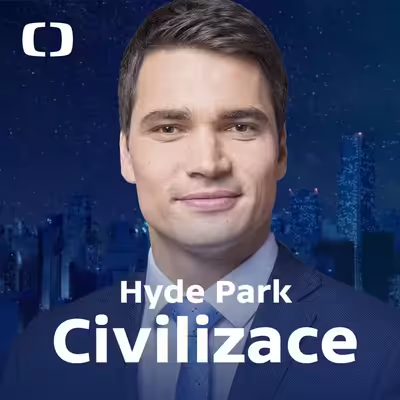
Hyde Park Civilizace

Hyde Park Civilizace

Věda a současná civilizace. Interaktivní rozhovory se světovými odborníky, ve kterých je prostor pro vaše otázky a komentáře. Moderuje Daniel Stach.

Podcast Hyde Park Civilizace je vložený na túto stránku z otvoreného informačného zdroja RSS. Všetky informácie, texty, predmety ochrany a ďalšie metadáta z informačného zdroja RSS sú majetkom autora podcastu a nie sú vlastníctvom prevádzkovateľa Podmaz, ktorý ani nevytvára ani nezodpovedá za ich obsah podcastov. Ak máš za to, že podcast porušuje práva iných osôb alebo pravidlá Podmaz, môžeš nahlásiť obsah. Ak je toto tvoj podcast a chceš získať kontrolu nad týmto profilom klikni sem.

Zoznam epizód (552 epizód)

53:41
  
19.02.2020

James W. Rice (planetary geologist)

The head of exploration missions on Mars. He managed exploration rover projects Spirit and Opportunity. He researches the surface of the red planet and participates in preparations for a human mission to Mars. The guest of Hyde Park Civilization was NASA astrogeologist James W. Rice, who came to the...
55:37
  
19.02.2020

ESO Special

From European Southern Observatory's headquarters, to La Silla, Paranal and Chajnantor. From planet hunter, spectrograph HAARPS, to the most advanced optical device on Earth, the VLT, to ALMA, array of 66 radiotelescopes in the altitude of more than 5 000 meters. We visited places that help us to le...
52:20
  
19.02.2020

Yoshinori Ohsumi (Nobel Prize in Physiology or medicine laureate)

A cleanup in the cell without which we wouldn't survive. That's autophagy - a process in which a cell gets ris of it's damaged or unnecessary parts and which seems to be also crucial in the fight against certain diseases such as Alzheimer's or Parkinson's disease, diabetes or cancer. Autophagy was d...
54:54
  
19.02.2020

Edward "Rocky" Kolb (cosmologist)

It looks like nothing is the mother of us all says professor Edward Kolb - cosmologists and astrophysicist also known by his nickname Rocky. In his research he focuses among other things on the very beginnings of our universe, on dark matter and dark energy. How can we find out what makes up 95% of...
55:34
  
19.02.2020

Sergei Krikalev (former Russian cosmonaut)

He's the man who was there - during the last days of the MIR space station as well as the early days of the International Space Station. He was a member of the first crew that started the project of uninterrupted human presence around Earth that continues to this day. He is the first Russian to fly...
52:46
  
19.02.2020

Paul Modrich (Nobel Prize for Chemistry laureate)

He described a system that allows our DNA to repair itself, without these constant repairs, we wouldn't survive. Professor Paul Modrich, laureate of the 2015 Nobel Prize in Chemistry. He entered the big world of science from a relatively close community of a small town. He started saving for college...
54:40
  
19.02.2020

Ben Feringa (Nobel Prize in Chemistry laureate)

He builds machines that are thousand times smaller than a width of a hair. And with them he might cause revolution in medicine and in other fields. Professor Ben Feringa, laureate of the 2016 Nobel Prize in Chemistry. He managed to construct nanocars that can drive and could in the future for exampl...
54:04
  
19.02.2020

Fabiola Gianotti (director-general of CERN)

As the head of the Atlas detector, she was there when the Higgs boson was detected. As the head of CERN, she decides about the organization's future development. Fabiola Gianotti, director-general of the largest scientific center on Earth. She can combine music, mathematics and particle physics as w...
55:01
  
19.02.2020

Tim De Zeeuw (the director general of ESO)

Seven rocky planet, three of them in the habitable zone and all of them close to Earth. At least from the cosmic point of view. That is the Trappist-one system. It was discovered partially thanks to the scientists from the European Southern Observatory and it's far from their only success. They have...
54:22
  
19.02.2020

Ada Yonath (Nobel prize in Chemistry laureate)

Go after your curiosity. You need to have more curiosity. Even more curiosity. But it’s not enough to be curious. You have to have passion. Says Professor Ada E. Yonath. She comes from a poor family, but eventually made her way to the highest levels of science. She studies ribosomes – factories insi...
54:49
  
19.02.2020

Reinhold Messner (mountaineer, adventurer)

The first person who climbed all 14 eight-thousanders. The first person who climbed Mount Everest without supplemental oxygen, the first person who climbed Mount Everest alone. A man who often went where no one went before. A man who says "summit is secondary, trying is the most important thing". Re...
53:36
  
19.02.2020

Claude Cohen-Tannoudji (Nobel prize in Physics laureate)

It is important to have crazy ideas because crazy ideas are sometimes good ideas. And a good researcher is student forever. Says Claude-Cohen Tannoudji who recieved the 1997 Nobel prize in physics for the development of method to cool and trap atoms with laser. These methods allow us for example to...
54:42
  
19.02.2020

Eric Betzig (Nobel Prize in Chemistry laureate)

He says he had two mid-life crisis. The first one when he got an idea and the second one when he implemented it. Today he is Nobel Prize laureate - professor Eric Betzig came up with a method that makes is possible to watch throught optical microscopes things that are only few nanometers big. One na...
54:21
  
19.02.2020

Dan Shechtman (Nobel Prize in Chemistry laureate)

You should look around and pay attention to something odd, says Daniel Schetman, professor at Technion, Israeli institute of technology. And he did find something odd. He found quasicrystals and that's why he received the Nobel prize in chemistry in 2011. However, he had to fight for recognition for...
54:48
  
19.02.2020

Harald Zur Hausen (virologist)

Around a quarter of million women around the world die every year of cervical cancer. Protection is vaccination. Prior to the development of vaccine it was necessary to find out what the cause of the disease is. And that is what professor Harald zur Hausen did. He discovered papilomaviruses that cau...
54:44
  
19.02.2020

Bernard Bigot (director-general of ITER tokamak)

In a special broadcast of Hyde Park Civilisation we visit Institute of plasma physics of the Czech Academy of Sciences. The reason is simple - our guest is head of International Thermonuclear Experimental Reactor. ITER should bring a revolution into harnessing of power - clean, safe and virtually in...
54:08
  
19.02.2020

Irina Bokova (director-general of UNESCO)

This cultural cleansing is a warcrime that is now used as a tactics of war. Says Irina Bokova, director general of UNESCO, when she described the destruction of monuments - among others - in Syria and Iraq. How to prevent terrorists from destroying thousands of years old statues or buildings? What o...
54:51
  
19.02.2020

Johann-Dietrich Wörner (director general of European Space Agency)

After the beginnings of astronomy, after the times of Apollo programme and ISS a new era is about to start. It will include for example village on the Moon as well as journey to Mars. This is how the current of state of space exploration is decribed by the director general of ESA, professor Johan-Di...
55:01
  
19.02.2020

Douglas Vakoch (President of METI International)

Dr. Douglas Vakoch, President of METI International – an organization that keeps pushing the SETI project. Literally further into space. He and his team are searching for extraterrestrial civilizations and are working on a message that they want to send to space. How should it be written? What shoul...
55:02
  
19.02.2020

Professor Benno Willke

„Ladies and gentlemen, we have detected gravitational waves. We did it.“ Said David Reitze, LIGO Laboratory Executive Director. And Einstein´s theory of relativity was proven. Moreover, scientists have opened a new window into space. They are comparing it to the moment when Galileo Galilei turned hi...
57:46
  
19.02.2020

Hyde Park Cilizace ENG - Jerome Friedman (co-discoverer of quarks)

Professor Jerome Friedman was awarded the Nobel Prize for the discovery of quarks – the smallest known particles in nature. He has been working at MIT for 65 years now, and one of his teachers was Enrico Fermi – one of the fathers of the first nuclear reactor and the atomic bomb. What was he like in...
58:18
  
19.02.2020

Paul Nurse (geneticist)

A laureate of the Nobel Prize in Physiology. A president of the British Royal Society. A pilot, biker, innovator and experimenter who failed a university entrance exam six times. Sir Paul Nurse. He researches the division of cells – the fundamental question for cancer research. Why did he research o...
58:19
  
19.02.2020

Scott Parazynski (astronaut)

He went to space five times. He was a part of the first US-Russian space walk. He kept improving the safety of space shuttles after the Columbia disaster. He violated NASA regulations to save equipment worth billions of dollars. How did it feel to walk in space? How did John Glenn, the first US astr...
57:38
  
19.02.2020

Gerard't Hooft (theoretical physicist)

Gerard 't Hooft. A laureate of the Nobel Prize in Physics. He described how particles behave after they collide and elucidated the quantum structure of electroweak interactions. He says that we will have intelligent computers. And that Mars should be a one-way ticket only. And that we all should bui...
56:05
  
19.02.2020

Timothy Snyder (history professor)

There are bloodlands between Hitler’s empire and Stalin’s empire. The victims of the biggest demographic and humanitarian catastrophe that man has ever caused in human history. A total of 14 million people died in less than two decades due to the politics of two leaders. History professor Timothy Sn...
Táto webová stránka používa súbory cookies, ktoré sú potrebné pre správne fungovanie a skvalitňovanie webovej stránky. Ďalšie informácie o tom, ako používame súbory cookies, nájdete tu.
Bližšie informácie o spracúvaní osobných údajov ako aj o súboroch cookies nájdete tu.

Technické cookies

Vždy aktívne cookies sú nevyhnutne potrebné na základné fungovanie. Bez týchto súborov by sme nemohli poskytovať služby, ktoré umožňujú tejto stránke fungovať.

Funkčné cookies

Funkčné cookies vylepšujú fungovanie webových stránok, nakoľko si môžu pamätať napríklad informácie ako používateľské meno, jazyk alebo preferovanú polohu. Vďaka zapamätaniu si Vašich volieb môže stránka poskytovať vylepšené a osobnejšie služby.

Analytické cookies

Tieto cookies zhromažďujú anonymné informácie o tom, ako používatelia využívajú webové stránky. Z týchto dát sa dozvieme, ako používatelia reagujú na stránku poskytnutím informácií o tom, aké oblasti navštívili, aký čas na našej stránke strávili, a či sa pri tom vyskytli nejaké problémy, napríklad chybové hlásenia, čo nám pomáha vylepšovať webovú stránku.

Marketingové cookies

Marketingové cookies pomáhajú sledovať Vaše online návštevy a aktivitu na našich webových stránkach. Uvedené pomáha poskytovať a zobrazovať Vám relevantnejšie reklamy alebo obmedzujú počet zobrazení reklamy. Tieto súbory cookie môžu zdieľať tieto informácie s inými organizáciami alebo inzerentmi. Ide o trvalé súbory cookie a takmer vždy pochádzajú od tretích strán.